
From Postwar Butoh to a Contemporary Rebellion of the Body
Dominique Savitri Bonarjee presented her book Butoh, as Heard by a Dancer (Routledge, 2024). This monograph is the outcome of a five-year embodied research project carried out in Japan, grounded in the model of direct transmission, in which learning takes place through long-term close proximity between student and teacher, and through the cultivation of subtle forms of understanding beyond words.
On 29 January 2026 Daiwa Foundation, London was delighted to host a book launch event, ‘From Postwar Butoh to a Contemporary “Rebellion of the Body”’, with Dominique Savitri Bonarjee.
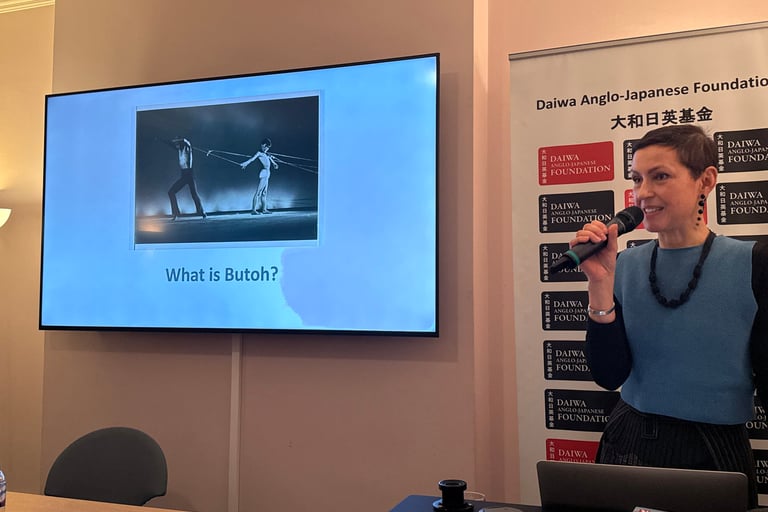
At the event, Bonarjee introduced ‘Butoh, As Heard by a Dancer’, based on her research in Japan, where she approached Butoh not academically, but rather as knowledge to be absorbed and embodied through practice and direct interaction. The book, which centres on ten conversations with dancers, artists and a philosopher, explores Butoh as a form of embodied listening and direct transmission.
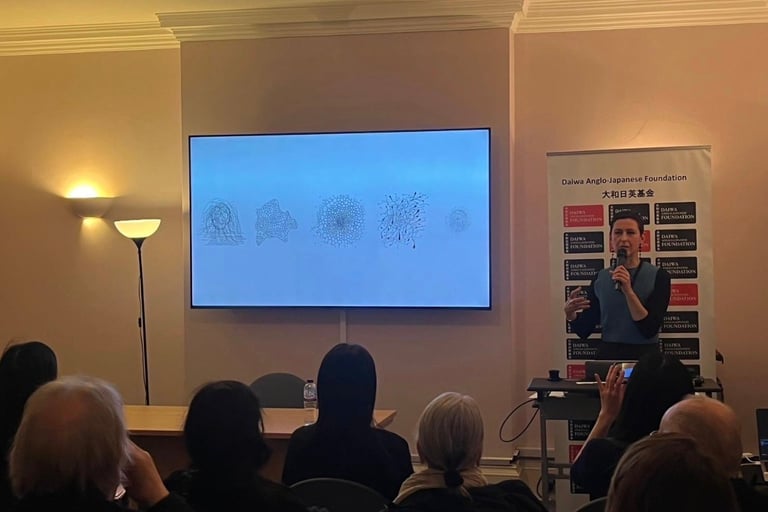
A central concept is direct transmission, akin to the Indian guru–disciple system (Guru-Shishya Parampara), emphasising proximity, trust, commitment and obedience. Bonarjee explained that Butoh is not linear, but resembles a rhizome or field of wildflowers, spreading in multiple directions. Key themes include emptiness and darkness, encouraging practitioners to shed social roles, labels and preconceptions to open their bodies to the unknown. Her presentation also addressed the relationship between Kazuo Ono and Tatsumi Hijikata and their exploration of gender, post-war Japanese identity and Butoh as a form of bodily and political rebellion.
In the end, Bonarjee introduced her own practice, including ‘Collapse’ performances, collective urban interventions and exercises to intensify the experience of time, using the body as a medium of resistance. A contemporary extension of this work is the project, ‘Scores for Unknowing’, which combines Butoh, AI and handcrafted technology. She mentioned that AI serves not to produce knowledge, but to generate states of the unknown, enabling participants to explore unpredictability and bodily responsiveness.
Daiwa Foundation would like to thank Bonarjee for guiding us through her interesting project and book.

Community
Exploring embodied knowing through the legacy of postwar Butoh.
Newsletter & UPDATES
© 2024. All rights reserved.